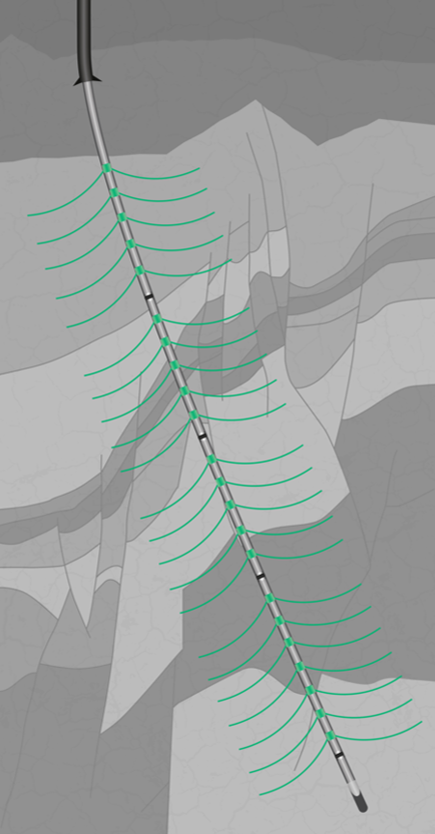
Improve reservoir exposure without the complexity
By creating multiple laterals that extend from the main wellbore into the surrounding formation, Fishbones significantly increases the probability of intersecting productive fractures. Instead of relying on a single wellbore to encounter a limited number of fractures, the branching architecture establishes numerous flow pathways, improving reservoir contact and enhancing productivity. Increasing connectivity to natural fractures is a stated benefit of the Fishbones approach.
This approach is particularly valuable in heterogeneousbasement reservoirs, where fracture intensity, orientation and connectivity canvary significantly along the well trajectory. The multiple branches effectively increase the stimulated reservoir volume and reduce dependency on the exact placement of the main wellbore, providing a more robust reservoir connection.
Fishbones Drilling technology is deployed as part of the lower completion and uses circulation from the rig pumps to simultaneously drill multiple small-diameter laterals into the reservoir. This enables operators to improve reservoir exposure without the complexity, cost and environmental footprint associated with e.g. large-scale hydraulic fracturing. Fishbones material highlights operational simplicity, a low environmental footprint and positive productivity responses in consolidated formations including basement formations.
- Increased reservoir connectivity
- Increase connection with natural fractures
- All branches made in one short pumping operation
- Suitable for hard formations such as granite and gneiss

Specialized well services across the full lifecycle